The third free set of 25 questions for the North Carolina DMV knowledge test (the written test many people call the NC permit test). None of these questions is in our other free tests. Same format as the real test: you need 20 correct to pass, and every answer comes with an explanation based on the current NC driver handbook. No sign-up.
25 questions
To pass: 20 of 25
13 with pictures
An explanation for every answer
✓Questions checked against the 2026 NC Driver’s Handbook
Question 1/25
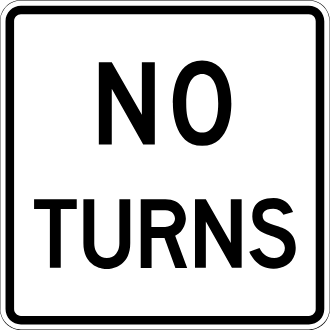
You planned to turn right at this corner, then you see this sign. The light is green and the way is clear. What should you do?
Turn right: the sign bans only left turns here
Go straight and turn at another intersection
Stop first, then turn right if no one is coming
Turn right now: the sign applies on red only
NO TURNS bans both left and right turns at this intersection, whatever the signal shows; it is not the same as NO TURN ON RED. The NC handbook says that failing to obey a regulatory sign is unsafe and a violation of traffic law, so go straight and turn where it is allowed.
Question 2/25
What color is a guide sign that points to a state park?
Blue rectangle
Green rectangle
Brown rectangle
Orange rectangle
The NC handbook's example is a brown rectangular PILOT MOUNTAIN STATE PARK sign; guide signs are rectangular and may be green, brown or blue. The general rule that brown marks parks, recreation and cultural sites comes from the federal MUTCD and is not stated in the NC handbook.
Question 3/25
This sign has no words. What does a green rectangular sign tell a driver?
A hazard on the road just ahead
A speed limit or another traffic rule
A nearby hospital or Highway Patrol station
Directions and distances to towns
A green rectangular sign is a guide sign: it gives directions and distances. The NC handbook says only that guide signs may be green, brown or blue; the meaning of green comes from the national sign standard (MUTCD). In the NC handbook, signs for a nearby hospital, Highway Patrol station or telephone are blue and white.
Question 4/25
At an intersection with no signs or signals, a car on your left has already entered the intersection when you arrive. Who has the right of way?
The one going straight, not turning
You, because you are to its right
The car on your left
Whichever car is traveling faster
The NC Driver Handbook says that at an intersection without signs or signals, the vehicle already in the intersection has the right of way over any vehicle that has not yet entered. The yield-to-the-right rule applies only when vehicles arrive at the same time.
Question 5/25
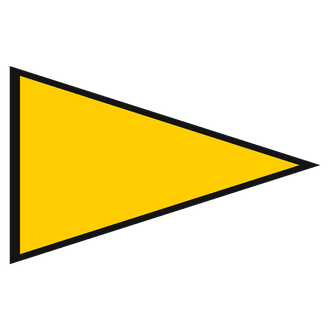
This yellow pennant has no words. Which rectangular regulatory sign does it emphasize, without replacing it?
DO NOT PASS
DO NOT ENTER
KEEP RIGHT
NO U-TURN
The pennant-shaped yellow warning sign emphasizes, rather than replaces, the rectangular DO NOT PASS sign. It stands on the left side of the road at the start of a no-passing zone.
Question 6/25
Inside city limits, a fire truck is answering a fire alarm. According to the NC Driver Handbook, how close to it may you drive or park?
No closer than 50 feet
No closer than 100 feet
Any distance, once it has passed you
No closer than one block
The NC Driver Handbook says do not drive or park closer than one block from fire trucks responding to a fire alarm, and never drive over a fire hose. Outside city limits the distance is 400 feet. The 100-foot rule is a different one: no parking within 100 feet of an emergency vehicle stopped at a crash.
Question 7/25
This sign is shown without its word, as on the NC sign test. What must you do when you reach it?
Slow down and go on if the road is empty
Yield to cross traffic without stopping
Come to a full stop, then go when clear
Stop only if you see cross traffic near
Eight sides mean a stop sign: the octagon is used for no other sign. The law requires a full stop, and you go on only when the way is clear. On the NC sign test the signs are shown without words.
Question 8/25
Which is true according to the NC Driver Handbook? I. In cities, about 2 of every 5 people killed in traffic crashes are pedestrians. II. In rural areas, pedestrians make up most of the people killed in traffic crashes.
Only I
Only II
Both I and II
Neither
Only I is true. The NC Driver Handbook says that in cities about 2 of every 5 people killed in crashes are pedestrians, and in rural areas only about 1 of every 10. Most pedestrians killed are children, elderly people or people who have been drinking.
Question 9/25
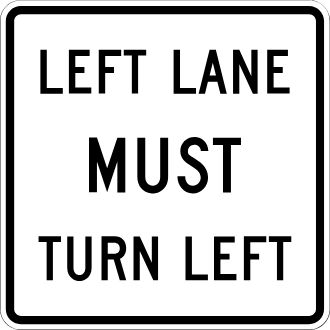
You wanted to go straight, but you notice this sign only when you are stopped first in line at a red light in the left lane, with cars beside and behind you. What should you do?
Go straight when the light turns green, watching for cars
Back up and move into the lane on your right
Turn left here, then find a way back to your route
Change lanes to the right while crossing the intersection
LEFT LANE MUST TURN LEFT: every driver in the left lane has to turn left, and the NC handbook says that failing to obey a regulatory sign is unsafe and a violation of traffic law. It also says never to change lanes while moving through an intersection, so make the turn and come back by another route.
Question 10/25
Is it illegal in NC to consume alcoholic beverages (including beer) while driving?
No, if your BAC stays below 0.08%
No, beer is allowed if you are 21 or older
Yes, but just for drivers under 21
Yes, for any driver and any drink
In NC it is illegal for any driver, of any age, to consume any alcoholic beverage while driving, including beer. It is also illegal to transport an open container of alcohol in the passenger area.
Question 11/25
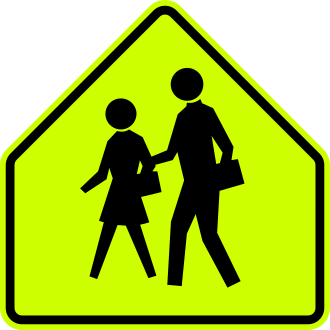
You see this sign. What should you do?
Come to a full stop at the sign, then go on
Keep your speed unless you see children
Watch the crosswalk: children will not cross elsewhere
Slow down and watch closely for children
This five-sided (pentagon) sign warns of a school zone or a school crossing. Slow down and be especially watchful for children in these areas; in many school zones the speed limit is reduced during certain school hours.
Question 12/25
What is the penalty for a third DWI conviction if one prior conviction was within the past 5 years?
A 4-year license revocation
Permanent license revocation
A $1,000 fine with no revocation
Community service only
A third DWI conviction (if at least one prior was within 5 years) results in permanent license revocation. The DMV may conditionally restore it only after at least 3 years and under strict conditions (G.S. 20-19(e1)).
Question 13/25
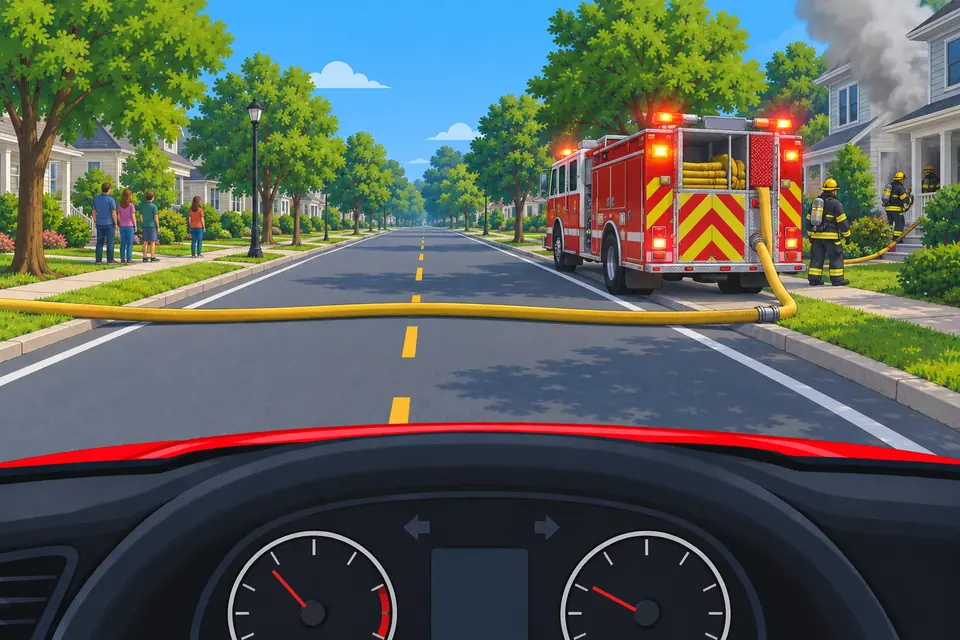
Firefighters are working a fire and a fire hose lies across the street. What should you do?
Do not drive over it: detour or wait
Drive over the hose slowly so you don't damage it
Drive over it if no water is flowing
Drive over it if no firefighters are nearby
Under G.S. 20-157(d), it is illegal at any time to drive over a fire hose or other equipment being used at a fire. You also may not follow a fire truck answering an alarm closer than one block, or drive or park within one block of where it has stopped (400 feet outside city limits).
Question 14/25
After your arrest, a test shows a BAC of 0.08% or more. Under NC law, what happens to your license?
Immediate revocation for at least 30 days
You keep your license until the court decides
Only a fine; you keep your license
Only a written warning from the officer
At a BAC of 0.08%+ (0.04% for commercial), your license is revoked immediately for a minimum of 30 days.
Question 15/25
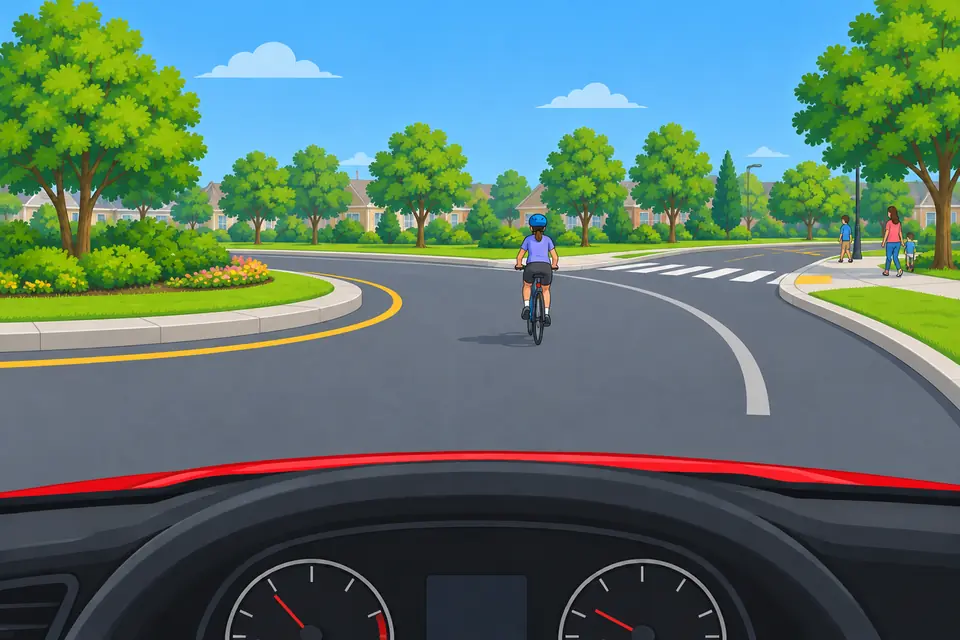
A bicyclist is riding ahead of you inside a roundabout. What should you do?
Pass while the circle is clear
Do not pass; follow until you exit
Honk so the rider moves to the edge
Pass using the other lane of the circle
Per the NC handbook, drivers should not pass a bicyclist inside a roundabout. In a multi-lane roundabout the cyclist picks a lane before entering and rides in the middle of it, not along the edge. Stay behind the cyclist inside the roundabout.
Question 16/25
You took an over-the-counter allergy pill that can cause drowsiness. Which is true?
DWI covers only alcohol, so you may drive
You may drive if you kept to the label dose
If it impairs your driving, you can be charged with DWI
No prescription was needed, so it cannot affect driving
Many medications (even over-the-counter) cause drowsiness or slow reactions. Driving impaired by them is dangerous and can lead to a DWI charge. Read the package warnings.
Question 17/25
According to the NC Driver Handbook, when should you leave more than the normal following distance?
On wet, slippery pavement
Where wildlife may be on the road
Behind a motorcycle on a slippery road
All of the above
The handbook's normal gap is the two-second rule. It says to increase it: at least double on slippery wet pavement, where stopping distances are 2 to 10 times longer; where wildlife may cross, so you can stop if the car ahead brakes hard for an animal; and behind a motorcycle or moped on slippery surfaces, because it has only two wheels on the road.
Question 18/25
You are convicted of driving more than 15 mph over the limit while going faster than 55 mph. For at least how long is your license revoked?
30 days
60 days
90 days
1 year
The NC Driver Handbook says your license is revoked for at least 30 days for driving more than 15 mph over the limit at a speed above 55 mph. A second such charge within one year, or speeding plus reckless driving at the same time, means 60 days.
Question 19/25
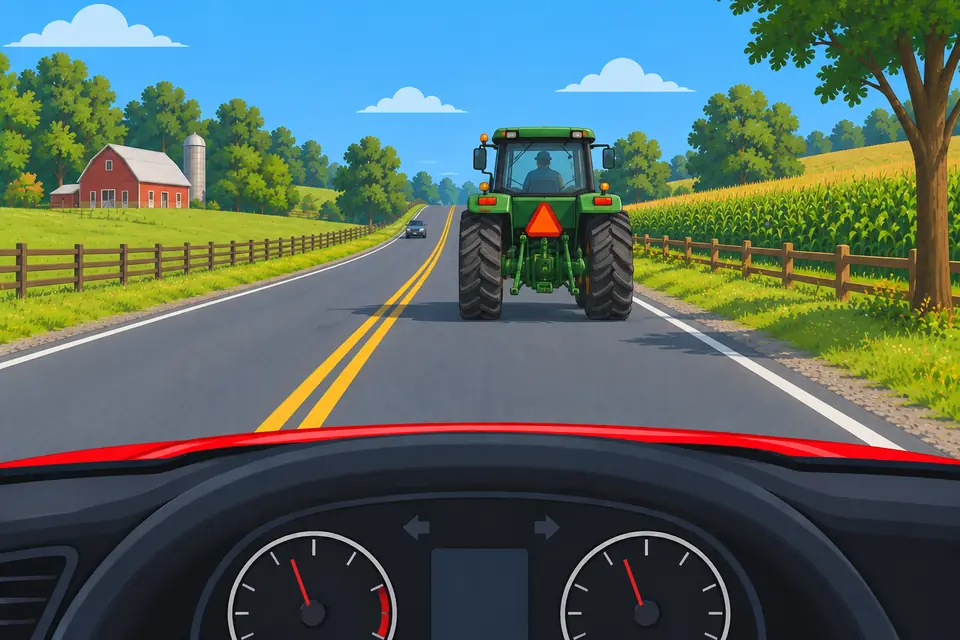
How should you safely behave around farm equipment (a tractor) on the road?
Pass only when the tractor pulls off to let you by
Pass right away, even on a curve, so you don't lose time
Honk so the tractor pulls onto the shoulder
Follow closely so the tractor driver sees you
Farm equipment is slow and often turns left into fields. Slow down, keep your distance and be patient. It is illegal to pass it in a no-passing zone. The NC handbook says that if farm equipment is holding up traffic, the operator should pull off the road at the nearest practical place and let traffic pass, and that this is the only advisable time to pass it.
Question 20/25
While driving your car, you were in a crash that by law had to be reported, and you did not report it. If convicted, how many DMV points are added?
2 points
3 points
4 points
5 points
The NC Driver Handbook point table gives 3 points for failure to report an accident where a report is required. You must report a crash to law enforcement at once if anyone is killed or injured, or if the damage appears to be $1,000 or more.
Question 21/25
At 55 mph you look at a text for about 4 seconds. According to the NC handbook, about how far does your car travel in that time?
About one car length
About 50 feet
About the length of a football field
About the width of a four-lane highway
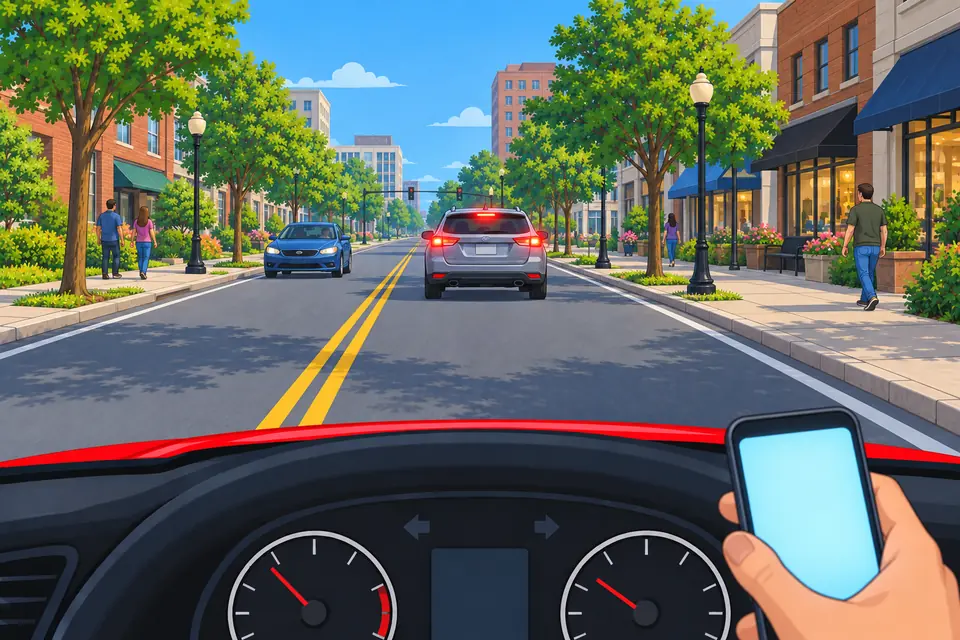
The handbook: at 55 mph, a vehicle travels the length of a football field in 3.7 seconds. So a 4-second look at your phone means covering about a whole football field without watching the road. Distracted drivers react more slowly and more often miss hazards such as pedestrians or debris. Texting while driving is illegal for all NC drivers, and drivers under 18 may not use a cell phone at all except to call 911 in an emergency or to call a parent, legal guardian or spouse (G.S. 20-137.3).
Question 22/25
You park beside a car that is already parked at the curb, on its roadway side, and run into a shop. What does the NC Driver Handbook say?
This is double parking: not allowed
It is allowed if your flashers are on
It is allowed, but for 5 minutes at most
It is allowed on one-way streets only
The NC Driver Handbook lists parking on the roadway side of another vehicle (double parking) among the places where you should not park. Look for a legal space at the curb instead.
Question 23/25
A police car behind you turns on its lights, but there is no safe place to stop nearby. What should you do?
Stop right away in your travel lane, wherever you are
Speed up to find a convenient exit sooner
Keep driving as usual, with no signal, until a spot comes up
Turn on hazards, slow down, find a safe spot
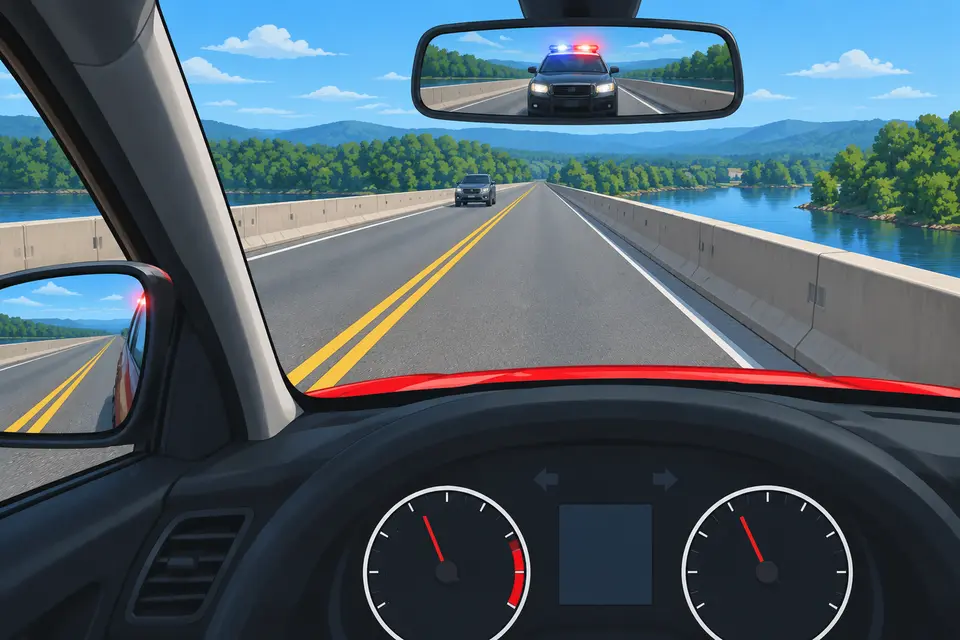
Per the NC handbook, if there is no safe place to stop right away, turn on your hazard flashers and slow down by about 10 mph so the officer knows you are aware of them. Keep obeying traffic laws until you reach the nearest safe area, then pull over to the right, off the travel lanes. If you doubt that an unmarked car is real police, you may call 911.
Question 24/25
Under NC law, what is the highest top speed a vehicle can have and still count as a moped?
25 mph
30 mph
35 mph
45 mph
Under G.S. 20-4.01(27)j, a moped has two or three wheels, no external shifting device, a motor of no more than 50 cc, and cannot go faster than 30 mph on a level surface. Models faster than 30 mph are not mopeds in NC.
Question 25/25
What should you do if your right wheels drift off onto a soft shoulder?
Turn the wheel sharply to get back on at once
Ease off the gas, go straight, ease back later
Brake hard right away and hold the wheel straight
Speed up a little and steer back onto the pavement
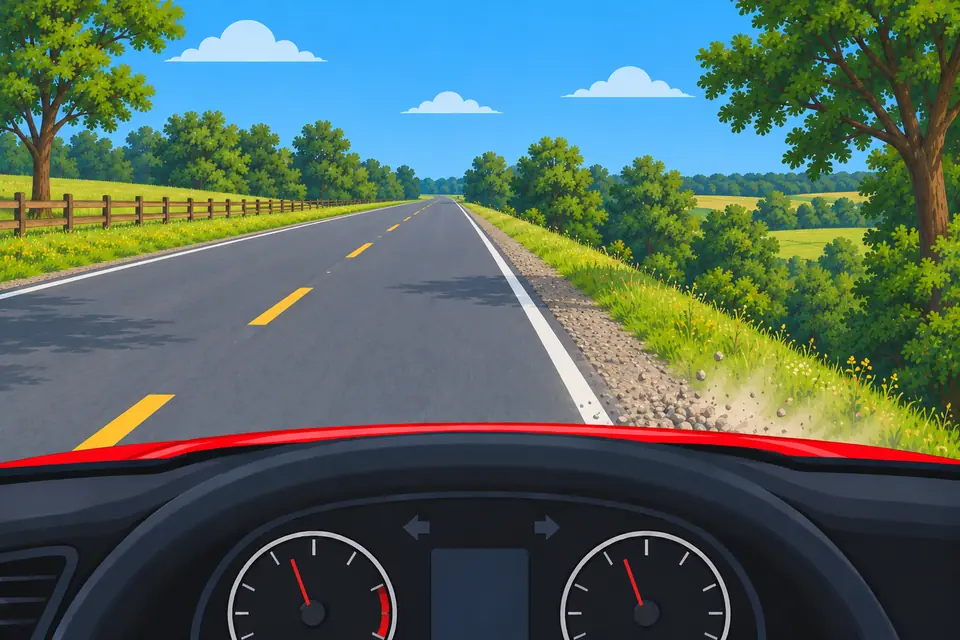
Don't brake hard or yank the wheel back; it can cause a skid or rollover. Ease off the gas, steer straight along the shoulder and let the car slow. When you are nearly stopped and traffic is clear, ease back onto the road.
✓One-time payment, no subscription or auto-renewal
✓No sign-up: your account uses your payment email
✓Failed on your first try within 30 days of payment? Send a photo of the result and we refund you within 5 business days (Terms)
NC issues licenses with an SSN; without one, only to people not eligible for an SSN, on documents of lawful presence. An ITIN is not accepted. If you cannot get a license, this course will not help.
💳 Card payments are processed by Stripe. Sales tax, if your state charges it, is added on the payment page.
Your account is created automatically when you pay, using the email you enter on the payment page. We send a link to that email so you can set your password. If an account with that email already exists, the access is added to it.
Already have an account? Log in before you pay so the access is added to that account. If you don’t, the access opens in the account for the email you pay with.
We will email you a review of your mistakes: each question you missed, the correct answer and the explanation. It helps you study before the test.
Your review arrives right away, followed by 2 more emails (a reminder and a list of tips). No spam: you can unsubscribe with one click. By submitting your email you agree to receive them; see the privacy policy.
What practice test 3 covers
Signs, signals and pavement markings: 7 questions
Right of way, school buses, railroad crossings: 5 questions
Alcohol, points and license rules: 4 questions
Speed and following distance: 2 questions
Safe driving: weather, night, emergencies, sharing the road: 7 questions
The questions cover the main topics of the North Carolina driver handbook. The sign test is separate at the DMV: 12 signs shown without words, and you must identify 9. Practice it with our North Carolina road signs guide.
Before the real test
The knowledge test usually has 25 questions; the official rule is 80% correct (19A NCAC 03B .0201), which is 20 of 25. If you do not pass, you can retake it after 7 calendar days. The full guide to the test format is on free practice test 1.
Written and checked by the Driver-Prep team against the current North Carolina Driver Handbook (revised May 2025). Updated .
Driver-Prep is an independent educational project. We are not affiliated with the NCDMV or the NCDOT; the practice questions are written from the official North Carolina driver handbook.
 RU
 Español