
 RU
RU
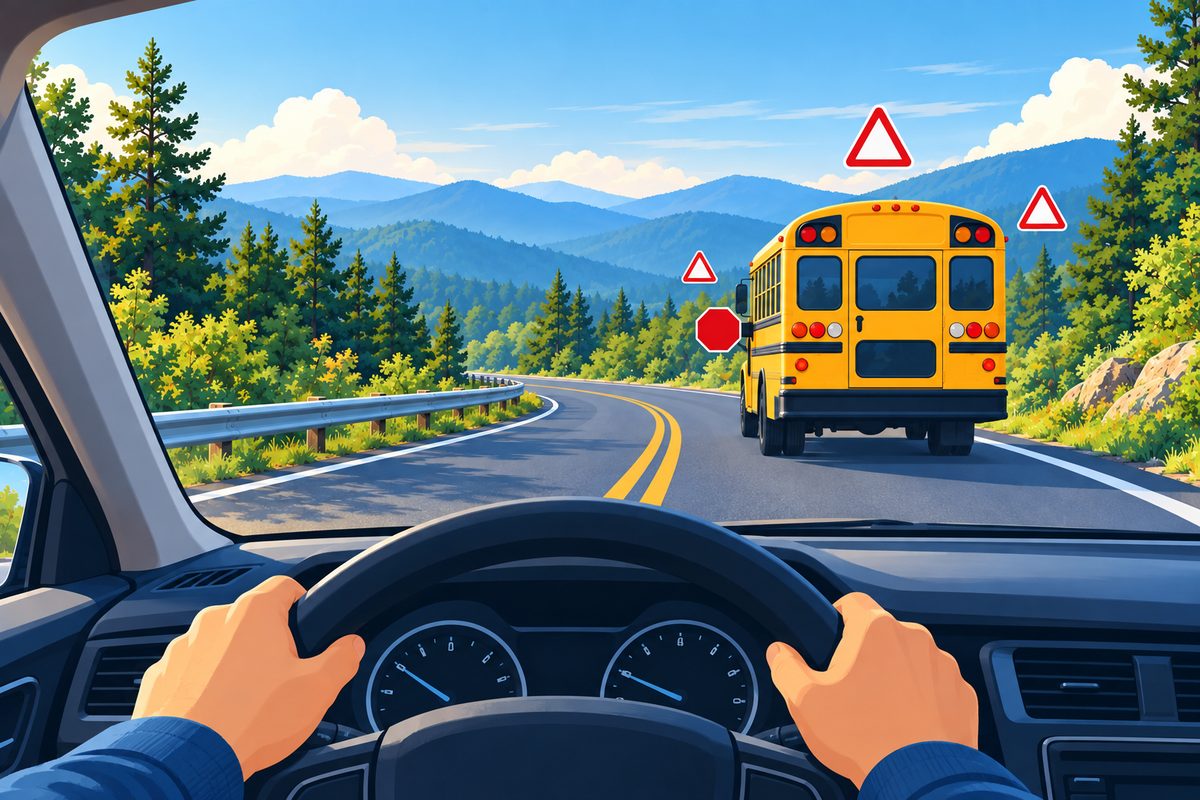
The most common mistakes on the North Carolina DMV test rarely come from not knowing traffic rules. They come from rules that change from state to state, or from details that seem familiar and are not. This review helps you avoid ten typical slip-ups. Keep the structure in mind: 25 knowledge questions (you need 20 correct, or 80%) and a separate road sign test (9 correct out of 12).
Mistake 1. Mixing up the school bus rule
What people get wrong: thinking you only have to stop when the bus is coming toward you.
The correct rule:
- Two-lane road, no median: if a school bus has stopped with flashing red lights and the stop arm extended, traffic in both directions must stop, including oncoming traffic.
- Divided highway with a median: only traffic going in the same direction as the bus must stop. Traffic on the other side may keep going.
The violation is a misdemeanor with a minimum fine of $500 (G.S. 20-217) and adds 5 points. More in our guide to NC driver's license points.
Mistake 2. Turning right and left on red
What people get wrong: believing you must always stay stopped on red, or believing you can turn left on red in North Carolina.
The correct rule: a right turn on red is allowed unless there is a "NO TURN ON RED" sign. First come to a complete stop, yield to pedestrians and to oncoming traffic, and only then turn. A left turn on red is prohibited in North Carolina, even from a one-way street onto another one-way street (G.S. 20-158). This is an exception: many states do allow it.
Mistake 3. Mixing up YIELD and STOP
What people get wrong: believing YIELD only means slowing down a little.
The correct rule: the YIELD sign (a triangle pointing down) requires you to give way to traffic and pedestrians who have the right of way. If no one is coming, you may continue without stopping, but you must be ready to stop. If there are vehicles with the right of way, you must stop and let them pass. The STOP sign (red octagon) always requires a complete stop, even if you see no one at the intersection.
Mistake 4. Passing where you cannot
Do not pass where you cannot see at least 500 feet ahead (on any curve or hill), at intersections, at railroad crossings, or where there is a solid yellow line on your side. One legal detail: to pass a bicycle or moped you leave at least 2 feet of clearance; in a no-passing zone, the distance is 4 feet or you move fully into the opposite lane (G.S. 20-150).
Mistake 5. Not knowing what each pavement marking says
- A broken yellow line is used as the center line of the road.
- A solid yellow line on your side prohibits passing.
- Solid white lines mark the right edge of the road.
The official handbook explains them in the chapter on signs and markings. The colors and shapes of signs are in our guide to road signs.
Mistake 6. Memorizing only one alcohol limit
What people get wrong: remembering only the 0.08% for adults.
BAC limits in North Carolina:
- 21 or older, regular driver: 0.08%.
- Commercial license (CDL): 0.04%.
- Under 21: 0.00% (zero tolerance).
- 0.15% or more: an aggravating factor, with harsher penalties, and the court may require an ignition interlock device (G.S. 20-17.8).
The typical mistake is applying 0.08% to a commercial driver or to a driver under 21.
Mistake 7. The headlight rules
- Headlights are required from sunset to sunrise (G.S. 20-129), and also when you cannot see people or vehicles 400 feet ahead.
- High beams: in a city at night use low beams; on the open road use high beams, unless you are approaching or following another vehicle.
- Dim them within 500 feet of an oncoming vehicle, and within 200 feet when following another vehicle.
The "30 minutes before sunset" rule belongs to other states, not North Carolina. On the test, answer "sunset to sunrise."
Mistake 8. Following distance: 2 seconds
Many sites talk about "3 seconds," and as a safety habit it is a good one. But the official North Carolina handbook teaches the two-second rule, and that is the one to mark on the test. Pick a fixed point on the road; when the vehicle ahead passes it, count "one thousand one, one thousand two." If you get there before 2 seconds are up, increase your distance. On the road, a bigger gap gives you more margin.
Mistake 9. Emergency vehicles stopped on the road
If an emergency or public service vehicle is stopped within 12 feet of the road with its warning lights on, you must move into a lane that is not the one closest to it. If you cannot change lanes safely (for example, on a two-lane road), slow to a safe speed and be ready to stop until you are past it (G.S. 20-157). The law does not set a speed in mph. Also, you may not park within 100 feet of an emergency vehicle that is giving assistance.
Mistake 10. Not knowing who yields in a roundabout
In North Carolina, a driver entering a roundabout yields to vehicles and cyclists already circulating in it. You travel counterclockwise. In a multi-lane roundabout, do not change lanes inside it, signal when you exit and yield to pedestrians at the crosswalks. Do not pass a cyclist inside the roundabout.
Extra: the numbers from the handbook
The test mixes miles, feet and seconds. A few figures worth having clear:
- At 55 mph, in ideal conditions, a vehicle needs about 211 feet to stop completely (a handbook figure).
- To pass, you need to see at least 500 feet ahead.
- Following distance: 2 seconds, per the handbook.
All of these rules are in the official NC Driver Handbook. To practice them, take the free 25-question practice test or the 400 questions with explanations. If you failed, see what to do next, and for the test format read how many questions are on the NC DMV test.